
Research & publications

Designing and evaluating behaviour change at scale

Across more than two decades, this body of work spans the full arc of behaviour change science, from developing and evaluating the MEND programme to building and testing large digital behaviour change platforms in obesity management. Across RCTs, population studies, and real-world deployments, the common thread is understanding what it takes to change behaviour at scale and doing it safely.

View full ORCID record

27

Peer-reviewed works on ORCID

24

Years of published research, 2002 to 2026

16

Academic institutions collaborated with, across six countries

Featured research

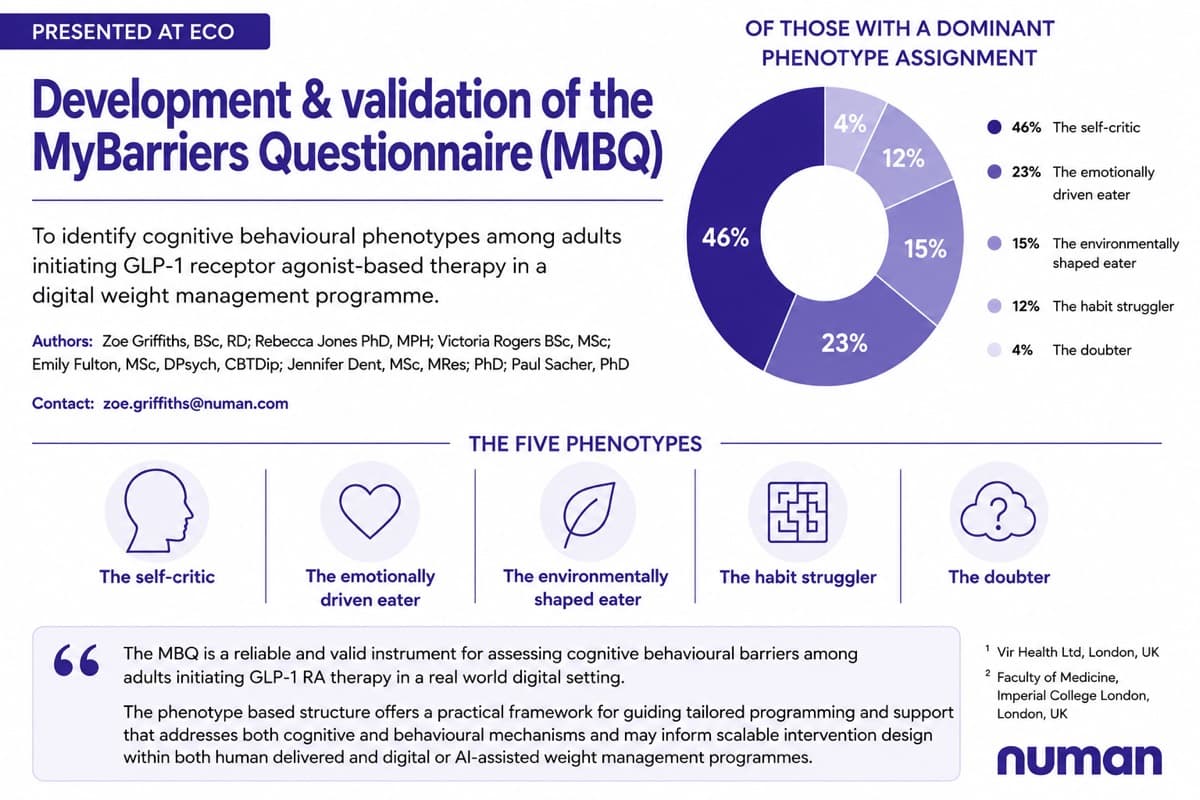
MBQ study presented at ECO 2026

The MyBarriers Questionnaire (MBQ) study was designed to identify cognitive behavioural phenotypes among adults initiating GLP-1 receptor agonist-based therapy within a digital weight management programme.

The Sacher AI team led the research in collaboration with the internal Numan team across two sequential studies, with validation in more than 400 participants, producing a structured, psychometrically evaluated, validated self-report tool.

The self critic
The emotionally driven eater
The environmentally shaped eater
The habit struggler
The doubter

Presented at the European Congress of Obesity (ECO) 2026. Under peer review.

ECO 2026 MyBarriers Questionnaire poster showing five behavioural phenotypes in GLP-1 digital weight management

Research with partners

Evidence built alongside the teams delivering care.

Numan

Behavioural phenotyping in GLP-1 care

The Sacher AI team led the phenotype study behind Numan's GLP-1 weight management programme, in collaboration with Numan, and includes named inventors on a pending US patent application for the resulting digital phenotyping system, which identifies the behavioural barriers people face when losing weight.

Allurion

Digital behaviour change and remote coaching

Led the behavioural science and research behind Allurion's text-based digital coaching, published as a peer-reviewed paper in JMIR Formative Research. In a 12-month study of 107 patients on a swallowable gastric balloon programme, the coaching was associated with significant improvements in mental wellbeing (P=.002) and weight-related quality of life (P<.001); 82% of patients found it helpful and 91% felt confident about making changes. Related work applied machine learning to flag likely non-responders early, so clinicians could intervene when it mattered most.

Read the peer-reviewed paper (JMIR Formative Research)

MEND

Family-based obesity in childhood, evidenced at scale

Co-founded MEND and led its research programme, including randomised controlled trials of a family-based intervention for obesity in childhood, delivered across communities in the UK and the US.

MEND randomised controlled trial, Obesity 2010

Slimming World

Behaviour change at population scale

Implementation and translation lead on NoHoW, a European Horizon 2020 randomised controlled trial of digital tools for weight-loss maintenance. Led the Slimming World work package and was a key member of the study team, working with a cohort of more than 2,000 successful maintainers at one of Europe's largest community weight-management services.

The NoHoW project, Obesity Facts 2021

Research collaboration

Behavioral AI Institute

Paul Sacher is co-founder and Research Director of the Behavioral AI Institute, an independent nonprofit advancing behavioural science as a core discipline in the design and evaluation of AI. With the Institute we co-authored the open letter The missing discipline in AI: a call for behavioural science in Wellcome Open Research, alongside leading behavioural scientists and now backed by more than 500 signatories, with further research in preprint.

Read the open letter in Wellcome Open Research ↗

AI safety and oversight

Even good AI needs a human in the loop.

In a multi-country evaluation of a patient-facing AI agent, spanning more than 1,300 conversations across 30 clinics in 9 countries and scored with our published FAST framework, around one in fifteen patient messages had to be escalated to a human clinician for a potential clinical or weight-loss concern. Patient-facing AI will always surface moments that need a person. That is exactly why we build safety evaluation and human oversight in from the start, rather than bolting them on later.

Publications

Peer-reviewed publications.

Behavioural AI, digital health and frameworks

2018-2026

Think FAST: a novel framework to evaluate fidelity, accuracy, safety, and tone in conversational AI health coach dialogues

Frontiers in Digital Health 2025

Behavioural AIDigital health

Neary M, Fulton E, Rogers V, Wilson J, Griffiths Z, Chuttani R, Sacher PM

doi.org/10.3389/fdgth.2025.1460236 · PMID: 40607190

Impact of a health coach-led, text-based digital behaviour change intervention on weight loss and psychological well-being in patients receiving a procedureless intragastric balloon programme

JMIR Formative Research 2024

Behavioural AIObesity management

Sacher PM, Fulton E, Rogers V, Wilson J, Gramatica M, Dent JE, Aarts EO, Eccleston D, Greve JW, Palm-Meinders I, Chuttani R

doi.org/10.2196/54723 · PMID: 39083340

The intersection of behavioural science and digital health: the case for academic-industry partnerships

Health Education and Behavior 2018

Behavioural AIDigital health

Hingle M, Patrick H, Sacher PM, Castro Sweet C

doi.org/10.1177/1090198118788600 · PMID: 30041556

Conversational AI in weight management

2024

Assessing perceptions and experience of using a novel AI conversational agent fine-tuned for patients on a swallowable gastric balloon programme

European Congress on Obesity (ECO) 2024

Behavioural AIDigital health

Sacher PM, Wilson J, Rogers V, Neary M, Fulton E

Conference abstract

A novel AI conversational agent fine-tuned for obesity treatment provides safe and accurate patient care: a multi-country study

European Congress on Obesity (ECO) 2024

Behavioural AIObesity management

Sacher PM, Neary M, Rogers V, Wilson J, Fulton E

Conference abstract

A novel conversational agent fine-tuned for bariatric treatment provides safe and accurate patient care: a multi-country study

ASMBS Annual Meeting 2024

Behavioural AIObesity management

Sacher PM, Neary M, Rogers V, Wilson J, Fulton E

Conference abstract

Procedureless balloon research

2023

Machine learning to predict success of response for patients treated with a procedureless balloon

Obesity 2023

Obesity management

Ainscough BJ, Sacher PM, Martinez C, Feldgoise J

Conference abstract · doi.org/10.1002/oby.23939

A path to automation: text-based coaching achieves key outcomes in patients with a procedureless balloon

Obesity 2023

Behavioural AIObesity management

Sacher PM et al.

Conference abstract · doi.org/10.1002/oby.23939

Digital appetite tracking enhances awareness of hunger and satiety in patients with a procedureless gastric balloon

Obesity 2023

Digital healthObesity management

Rogers V, Sacher PM et al.

Conference abstract · doi.org/10.1002/oby.23939

Personalized mHealth coaching in conjunction with a swallowable intragastric balloon improves psychological and mental wellbeing outcomes and programme satisfaction

Canadian Obesity Summit 2023

Behavioural AIObesity managementDigital health

Sacher PM, Fulton E, Rogers V, Wilson J, Gramatica M, Liu J, Chuttani R

Conference abstract

The importance of self-efficacy and perceived behavioural control on the achievement and maintenance of weight loss during treatment with an intragastric balloon and mHealth coaching programme

Canadian Obesity Summit 2023

Behavioural AIObesity management

Fulton E, Sacher PM, Griffiths S, Rogers V, Wilson J, Chuttani R

Conference abstract

eHealth and bariatric surgery

2019-2021

Evidence-based digital tools for weight loss maintenance: the NoHoW project

Obesity Facts 2021

Digital healthObesity management

Stubbs R, Duarte C, Palmeira A, Sniehotta F, Horgan G, Larsen S, Marques M, Evans E, Ermes M, Harjumaa M, Turicchi J, O'Driscoll R, Scott S, Pearson B, Ramsey L, Mattila E, Matos M, Sacher P, Woodward E et al.

doi.org/10.1159/000515663 · PMID: 33915534

Application and effectiveness of eHealth strategies for metabolic and bariatric surgery patients: a systematic review

Digital Health 2020

Digital healthObesity management

Messiah SE, Sacher PM, Yudkin J, Ofori A, Qureshi FG, Schneider B, Hoelscher DM, de la Cruz-Muñoz N, Barlow SE

doi.org/10.1177/2055207619898987 · PMID: 32030193

Partnering support interventions with bariatric surgery to maximise health outcomes in adolescents with severe obesity

Obesity 2019

Obesity management

Messiah SE, Sacher PM, Yudkin J, Qureshi FG, Hoelscher DM, Barlow SE

doi.org/10.1002/oby.22612 · PMID: 31562699

Obesity in childhood - population studies and RCTs

2010-2018

Addressing childhood obesity in low-income, ethnically diverse families: outcomes and peer effects of MEND 7-13 when delivered at scale in US communities

International Journal of Obesity 2018

Obesity management

Sacher PM, Kolotourou M, Poupakis S, Chadwick P, Radley D, Fagg J

doi.org/10.1038/s41366-018-0158-2 · PMID: 30076372

Efficacy of a community- versus primary care-centred programme for childhood obesity: TX CORD RCT

Obesity (Silver Spring) 2017

Obesity management

Butte NF, Hoelscher DM, Barlow SE, Pont S, Durand C, Vandewater EA, Liu Y, Adolph AL, Perez A, Wilson TA, Gonzalez A, Puyau MR, Sharma SV, Byrd-Williams C, Oluyomi A, Huang T, Finkelstein EA, Sacher PM, Kelder SH

doi.org/10.1002/oby.21929 · PMID: 28703504

Long-term outcomes following the MEND 7-13 child weight management programme

Childhood Obesity 2015

Obesity management

Kolotourou M, Radley D, Gammon C, Smith L, Chadwick P, Sacher PM

doi.org/10.1089/chi.2014.0092 · PMID: 25764056

Randomised controlled trial of the MEND programme: a family-based community intervention for childhood obesity

Obesity 2010

Obesity management

Sacher PM, Kolotourou M, Chadwick PM, Cole TJ, Lawson MS, Lucas A, Singhal A

doi.org/10.1038/oby.2009.433 · PMID: 20107463

Full publication record on ORCID (0000-0002-4374-7310).

Next step

Turn evidence into your next step

If you need research, evaluation, or stronger external credibility for your AI, book a discovery call.

Book a discovery call